




Key Takeaways
- Memorandum of Association is a mandatory legal document filed with the RoC as per the provisions of the Companies Act 2013.
- It contains six mandatory clauses: Name, Registered Office, Object, Liability, Capital, and Association.
- So, what is MoA? It specifies a company’s external powers; anything beyond it would be void (ultra vires).
- Changes in the MoA are possible only through Special Resolution under Section 13, with RoC and Central Government approvals.
A Memorandum of Association (also known as MoA) is the legal charter that defines how an Indian company can be brought into existence. It is the primary document filed with the Registrar of Companies (RoC), without which no company formation is possible. Having a proper understanding of the meaning of the MoA in business is very important. In this blog, we will break down its meaning, format, mandatory clauses, and the process for drafting and changing it.
Let’s get going then!
What is a Memorandum of Association? MoA Full Form & Meaning
What is MoA? Simply put, the memorandum of association is the all-important legal document that outlines a company’s name, registered office, objectives, members’ liability, and share capital. It legally controls a company’s relationship with the rest of the world. Section 2(56) of the Companies Act, 2013 describes it as the memorandum as originally framed or as altered from time to time under this Act or any previous company law. Similar to a MoA certificate of company formation, this document establishes a company’s identity and operational boundaries.
Various types of persons and entities can subscribe to an MoA:
- Individuals (Indian residents)
- NRIs (Non-Resident Indians)
- Minors, through a legal guardian
- LLPs (Limited Liability Partnerships)
- Body corporates and other registered entities
Minimum subscriber requirements vary by company type:
| Company Type | Minimum Subscribers |
| Public Company | 7 |
| Private Company | 2 |
| One Person Company (OPC) | 1 |
Importance of Memorandum of Association
Why is the Memorandum of Association (MoA) so crucial? It is because this document is not only a legal requirement but also a guiding force.
- Compulsory for incorporation: No company is allowed to be registered without filing a duly signed MoA with the Registrar of Companies (RoC).
- Specifies the scope of operations: A business entity cannot do anything outside what is written in its MoA. This provides transparency and averts abuse of corporate authority.
- Protects the stakeholders: Investors, creditors, and other stakeholders will use the MoA to know what the company can and cannot do.
- Legal Protection: The courts and regulators usually refer to the MoA to settle the legal disputes that arise about the power of a company to carry out specific actions.
Take the MoA as a lighthouse, it will help the company along the path, but it will be a reminder not to get into the shallow waters.
Key Features of Memorandum of Association(MoA)
The MoA is not just another piece of paper; it is a legally binding document with unique characteristics:
- Written and mandatory: It has to be in writing and filed with the RoC.
- Public document: Anyone can access it by paying a nominal fee to the RoC, ensuring transparency.
- Defines external relationship: It governs the company’s relationship with outsiders such as creditors, regulators, and investors.
- Binding on all members: Every shareholder, director, and officer of the company is bound by the clauses of the MoA.
Important Clauses of Memorandum of Association
The significance of the MoA is that it has clearly defined clauses of the memorandum of association. Each is responsible for a specific function. Collectively, they represent the very essence or the genetic makeup of a company. Below are the major clauses of the memorandum of association:
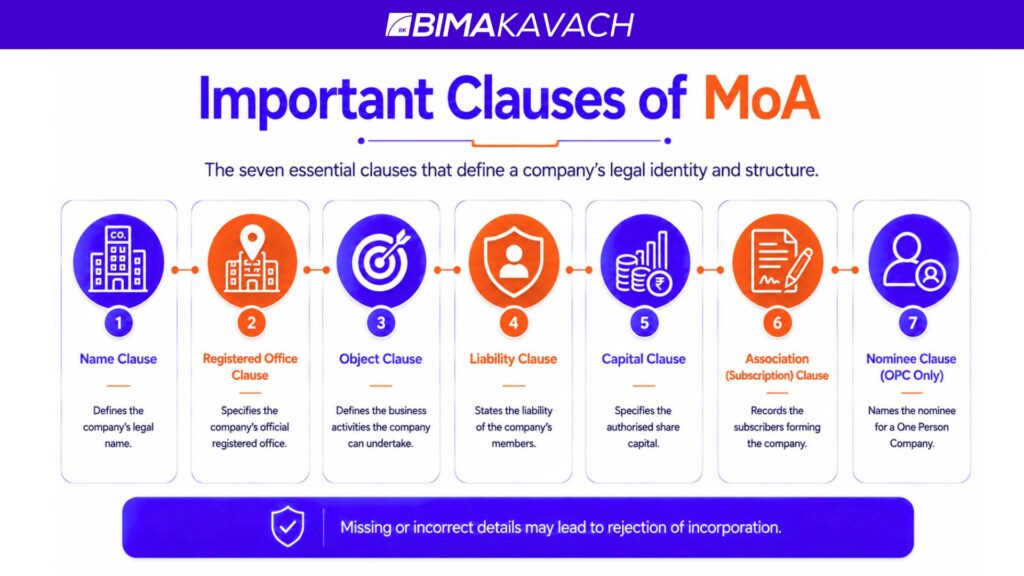
1. Name Clause
This clause identifies the registered or legal name of the company. Private limited companies are required by law to end their names with “Private Limited”. Similarly, public limited companies must have “Limited” at the end of their names. Besides, the proposed name for the company must conform to the Ministry of Corporate Affairs (MCA) guidelines. This is mandated to ensure that no duplication of names exists and that no name contains any inappropriate/objectionable words.
2. Registered Office (Domicile) Clause
This clause indicates the location of the registered office of the company. It is important because the address/location determines the jurisdiction of the Registrar of Companies (RoC) and applicable taxation.
3. Object Clause
Many believe that this is the most critical clause. It outlines the company’s primary objective along with any additional or secondary objectives. As per the law, the company is prohibited from carrying out any activities outside the scope defined in this clause.
For example, if a company’s Object Clause mentions it is incorporated for “manufacturing textiles,” it cannot legally venture into real estate development without formally altering this clause first.
4. Liability Clause
This states the liability of the members. In share-limited companies, the liability of the members is limited to the unpaid value of shares. In guarantee-limited companies, the same is limited to the amount that they have agreed to contribute.
5. Capital Clause
This clause states the authorised share capital of the company, i. e., the maximum capital it can raise through shares. It also describes how the shares are divided into different classes, such as equity and preference.
6. Association (Subscription) Clause
This clause records the names, addresses, and signatures of subscribers agreeing to form the company. It also lists the shares each subscriber has agreed to take.
7. Nominee Clause (OPC only)
This clause is only relevant for One Person Companies (OPCs). It names a nominee who shall occupy membership in case of the demise or incapacity of the sole member.
All seven of these clauses are indispensable. Any missing or inaccurate details can lead to incorporation rejection.
Format of Memorandum of Association Under Companies Act 2013
The MoA format is prescribed under the Companies Act, 2013. Different model templates have been provided under Tables A to E, based on company type.
Table A: Company Limited by Shares
| Table | Company Type | Key Feature |
| A | Limited by Shares | Liability limited to unpaid share value |
Example: “XYZ Technologies Private Limited,” registered in Maharashtra, objects stated as IT and software development services.
Table B: Company Limited by Guarantee (No Share Capital)
| Table | Company Type | Key Feature |
| B | Guarantee, No Share Capital | Members guarantee a fixed contribution on winding up |
Example: “Green Earth Foundation,” a non-profit environmental trust with no share capital.
Table C: Company Limited by Guarantee (With Share Capital)
| Table | Company Type | Key Feature |
| C | Guarantee, With Share Capital | Combines guarantee liability with issued share capital |
Example: “Skill Bridge Association Limited,” a training body with both guaranteed members and shareholders.
Table D: Unlimited Company (No Share Capital)
| Table | Company Type | Key Feature |
| D | Unlimited, No Share Capital | Members bear unlimited personal liability |
Example: “Heritage Trust Unlimited,” a family-run entity with no share capital.
Table E: Unlimited Company (With Share Capital)
| Table | Company Type | Key Feature |
| E | Unlimited, With Share Capital | Unlimited liability alongside issued shares |
Example: “Riverdale Traders Unlimited,” holding share capital with unlimited member liability.
Once drafted, the MoA is digitally signed using a DSC and filed through the SPICe+ form on the MCA portal.
How to Alter or Amend the Memorandum of Association
Amendment of the MoA is a legal process that is outlined under Section 13 of the Companies Act, 2013. Here’s how to alter the memorandum of association:
- Pass a Special Resolution in a General Meeting: Any proposed change must be approved by the shareholders through a Special Resolution at a duly convened General Meeting.
- File Form MGT-14 with RoC within 30 days: The company is required to file the form together with the resolution and explanatory statement within the specified period.
- Obtain Central Govt. approval: This is required if you shift the Registered Office from one state to another, i. e., in case of inter-state migration.
- File altered MoA with RoC: Once the company has incorporated the approved changes to the Memorandum of Association, it can be filed with the RoC for the record.
- RoC issues updated Certificate of Incorporation: The RoC modifies the company’s record and issues a certificate with a confirmation of the change.
Clause-wise Alteration Rules
| Clause | Type of Change | Approval Required | Form |
| Name | Change of company name | Special Resolution & Central Govt. approval | INC-24 |
| Object | Change in business objects | Special Resolution | MGT-14 |
| Registered Office | Same city/state | Board Resolution | INC-22 |
| Registered Office | Different state | Special Resolution & Central Govt. approval | INC-23, MGT-14 |
| Capital | Increase/reorganize share capital | Ordinary/Special Resolution (as applicable) | SH-7 |
| Liability | Change in liability structure | Special Resolution | MGT-14 |
Benefits of Memorandum of Association
A well-drafted Memorandum of Association can help your Company in many ways:
- Legal recognition: No company is allowed to register without an MoA. It is the very evidence of the company’s identity.
- Transparency: Being a public document, it helps create trust and confidence among the investors, creditors, and stakeholders as it discloses the company’s purpose and limits.
- Clear objectives: It stops directors from being involved in unauthorised activities and also ensures that the business activities are consistent with the shareholders’ interests.
- Investor confidence: Investors feel secure knowing the company’s scope and boundaries are well-defined.
- Corporate governance: It lays the foundation for compliance with laws and ethical practices.
In short, the MoA serves as both a sword and a shield. It empowers companies and protects stakeholders at the same time.
Difference Between Memorandum of Association (MoA) and Articles of Association (AoA)
The names of Articles of Association (AoA) and MoA are usually taken in the same breadth, but they are separate instruments, intended to serve very different purposes. Understanding the difference between MoA and AoA is necessary. The first one determines where the boundary lies, and the other specifies internal procedures.
| Parameter | MoA | AoA |
| Purpose | Defines the company’s charter and existence | Regulates internal management and operations |
| Contents | Name, objects, liability, office, capital, association | Rules for share transfer, meetings, voting, and directors |
| Scope | External relationship with outsiders | Internal governance between the company and its members |
| Filing Requirement | Mandatory at incorporation | Mandatory at incorporation |
| Subordination | Supreme document. AoA cannot override it | Subordinate to the MoA and the Companies Act |
| Amendment Process | Special Resolution. May need Central Govt./RoC approval | Special Resolution only |
| Ultra Vires Treatment | Acts beyond the MoA are void | Acts beyond the AoA can be approved by shareholders |
| Retrospective Amendment | Usually not retrospective | Can be applied retrospectively |
| Signatories | Signed by original subscribers | Signed by subscribers, adopted per company needs |
In short, MoA and AoA work together. The MoA defines what a company can do. The AoA defines how it does it.
Consequences of Non-Compliance with MoA
Violating or ignoring the Memorandum of Association can invite serious consequences. Actions that are out of the company’s stated scope are legally void and cannot be approved, even by shareholder consent. The Registrar of Companies and Courts has the right to impose penalties on companies that misrepresent or contravene their objectives. Besides, investors and creditors may refuse to honour dealings outside the stated objectives. Repeated non-compliance is considered a sign of poor governance. This, in turn, can damage the long-term credibility of the company.
Doctrine of Ultra Vires
This principle was firmly established in Ashbury Railway Carriage & Iron Co. Ltd. v. Riche (1875). Here, the House of Lords held that acts outside a company’s stated objects are void from the very beginning. These cannot be validated, even with unanimous shareholder approval.
Non-compliance can also invite statutory penalties:
| Offence | Penalty under Section |
| Fraudulent conduct/misstatement in the MoA | Section 447: imprisonment and fine |
| Punishment where no specific penalty is provided | Section 448: fine and/or imprisonment |
How BimaKavach Helps Incorporated Companies
Once you have put your company’s MoA and legal structure in place, the next important concern should be safeguarding the business and the people who run it. Directors assume personal liability as soon as a new company is incorporated. Therefore, the right business insurance cover becomes essential from day one. The seasoned advisors and experts at the BimaKavach platform are there to guide you to the right protection that fits your needs the best :
- Directors and Officers (D&O) Insurance: It protects directors from personal liability for decisions made on the company’s behalf.
- Professional Indemnity Insurance: Professional Indemnity Insurance covers financial losses arising from errors or omissions in professional services.
- Commercial Insurance: Includes across 13+ policy types tailored to your business needs
Frequently Asked Questions About Memorandum of Association
MoA stands for Memorandum of Association. It is the foundational legal document filed with the Registrar of Companies during incorporation under the Companies Act, 2013.
MoA defines a company’s external scope and relationship with outsiders, while AoA governs internal management, meetings, and share transfer rules between the company and its members.
The original subscribers, also called initial shareholders, sign the MoA under the Association Clause, agreeing to form the company and take up the shares mentioned.
Yes, the MoA is a public document available for inspection at the Registrar of Companies, allowing outsiders to verify a company’s objectives and legal boundaries.
A standard MoA contains six mandatory clauses: Name, Registered Office, Object, Liability, Capital, and Association. One-Person Companies additionally require a Nominee Clause.
Yes, the MoA can be altered by passing a Special Resolution under Section 13, followed by filing Form MGT-14 and obtaining necessary regulatory approvals.
Such acts are considered ultra vires, meaning legally void from the outset. Neither shareholders nor directors can ratify or validate actions beyond the stated objectives.
The Companies Act prescribes five model formats, Tables A to E, based on company type, such as limited by shares, guarantee, or unlimited liability.
Yes, an OPC must file an MoA with just one subscriber, along with a Nominee Clause naming a person to take over membership if needed.
The MoA is typically drafted by company secretaries or legal professionals, based on inputs from promoters, ensuring compliance with the Companies Act requirements and formats.
Conclusion
The Memorandum of Association is far more than a bureaucratic formality. In fact, it is the backbone of a company’s legal existence in India, defining its name, scope, and boundaries of operation. A properly drafted MoA ensures transparency, builds investor confidence, and keeps operations within legally sound limits. For every entrepreneur building a compliant corporate foundation, the memorandum of association remains essential.