




Partial and total disablement in labour law refers to the loss of an employee’s earning capacity, either temporary or permanent, resulting from a workplace injury. The Workmen’s Compensation Act 1923 mandates that employers compensate workers based on the severity of an injury and its effect on their ability to work. The law recognises different types of disablement, each with its own set of criteria and compensation framework. This guide explains what disablement is, its classifications and the method of determining compensation for each type, as per Indian labour law.
Here we go!
Key Takeaways
- Partial and total disablement in labour law refers to loss of earning capacity resulting from workplace injury.
- It is categorised into four types: temporary partial, permanent partial, temporary total, and permanent total.
- Compensation formulas differ as per type, wages, age factor, and Schedule I percentages.
- Employers must have WC insurance to fund their statutory liability for disablement claims.
Meaning of ‘Disablement’ in the Workmen Compensation Act 1923
So, what does “disablement” mean under Indian labour law? Well, disablement means the loss/reduction of an employee’s capacity to earn due to an accident arising out of and during employment. It is formally defined under Section 2(1)(g) of the Employees’ Compensation Act 1923 to reflect a wider, more inclusive coverage scope.
Disablement under the Act is bifurcated into two types: Partial Disablement and Total Disablement. Each carries distinct legal and financial implications for employers, as discussed in the next section.
Types of Disablement Under Labour Law
Under Indian labour law, the types of disablement are divided into two categories: partial and total, each of which can be either temporary or permanent. Hence, in totality, there exist four distinct categories: temporary partial, permanent partial, temporary total, and permanent total disablement. Together, they determine how partial and total disablement in labour law is assessed and compensated. We will explore this in sections below.
What is Partial Disability?
So what is partial disability? As per Section 2(1)(g) of the Employees’ Compensation Act, partial disablement in labour law means a reduction (not a complete loss) of an employee’s earning capacity resulting from a workplace injury. The nature of this reduction (whether temporary or permanent) depends on whether it affects only the particular employment held at the time, or all types of employment the worker was capable of.
Types of Partial Disability
The Act mentions two types of partial disablement depending on whether the reduction in earning capacity of the affected worker is temporary or permanent.
Temporary Partial Disablement
TPD applies when an injury diminishes earning capacity solely in the employment in which the employee is actually engaged at the time of the accident, not in all employment. This means the worker can still perform other work during recovery. For example, a warehouse worker who breaks his hand will be unable to lift heavy objects for a few weeks but will be able to carry out certain types of desk jobs in the meantime.
Permanent Partial Disablement
PPD occurs when an injury reduces the earning capacity of the worker in all types of employment he was capable of doing, not only the job he held at the time of the concerned injury. All injuries listed in Part II of Schedule I are presumed to result in PPD. For example, loss of a thumb for a machine operator (30% loss of earning capacity) or permanent partial loss of vision for a welder.
How is Workmen’s Compensation Calculated for Partial Disablement
As per Section 4 of the Employees’ Compensation Act, the compensation for partial disablement in labour law depends on the percentage loss of earning capacity specified in Schedule I, applied to the compensation for permanent total disablement. Some examples from Schedule I are as follows:
- Loss of a thumb = 30% loss of earning capacity
- Loss of an index finger = 14% loss of earning capacity
- Amputation of a leg below the knee = 50% loss of earning capacity
For calculation purposes, monthly wages are capped at Rs 15,000, even if the worker’s actual wages are higher, and an age-factor multiplier is applied to account for the worker’s remaining earning years.
The compensation formula for PPD = Loss of earning capacity (%) × Compensation payable for Permanent Total Disablement (60% of monthly wages, capped at Rs 15,000, × age factor from Schedule IV)
What is Total Disability?
Total disablement in labour law means the worker is completely incapable of carrying out any work that would earn him the same wages he was getting before the accident. This loss of working capacity may be temporary or permanent, based on whether recovery is expected.
Types of Total Disability
Total disablement can be either temporary (where the worker fully recovers after a period) or permanent (he loses his earning capacity for life).
Temporary Total Disablement
This disablement occurs when a worker is completely unable to perform any work for a specific recovery period, but he is expected to recover fully. For example, a delivery worker suffers from multiple fractures from a vehicle collision and, as a result, is unable to work for three months. The disablement is total (he can’t work at all) but temporary (time-bound).
Permanent Total Disablement
PTD leads to a loss of earning capacity for life. Every injury specified in Part I of Schedule I is deemed to result in permanent total disablement:
- Loss of both hands
- Loss of both feet
- Complete loss of sight in both eyes
- Loss of any two of the above (e.g., one hand and one foot)
- Complete deafness
- Paralysis due to spinal injuries
How is Workmen’s Compensation Calculated for Total Disablement
According to Section 4 of the Employees’ Compensation Act, compensation for total disablement in labour law is calculated by using a defined statutory formula. The same Rs 15,000 monthly wage capping applies, as was for partial disability cases.
The compensation formula for PTD = 60% of monthly wages × relevant age factor (Schedule IV), or Rs 1,40,000, whichever is higher.
In 2020, the statutory minimum compensation amount for PTD was revised to Rs 1,40,000, whereas in case of death claims the minimum amount was kept at Rs 1,20,000. Compensation for Temporary Total Disablement (TTD) is paid periodically at 25% of monthly wages per fortnight for the entire duration of the disablement, not as a lump sum.
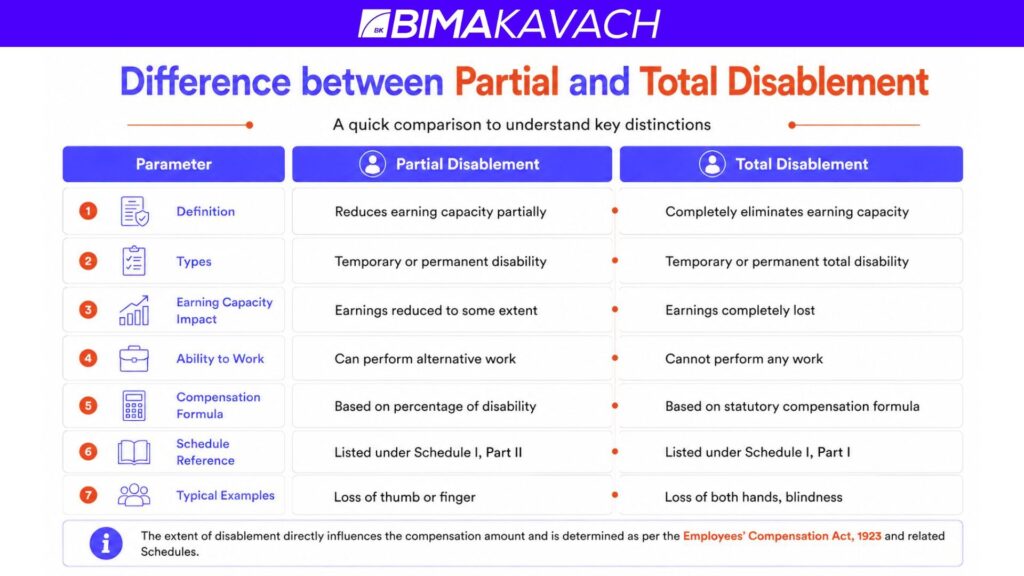
Difference between Partial and Total Disablement
Determining the difference between partial disablement and total disablement is vital for accurate compensation. Here is a comparison of the two:
Employer’s Liability for Compensation under WC Act
Under Section 3 of the Employees’ Compensation Act, an employer becomes liable to pay compensation for partial and total disablement in labour law when a personal injury is caused to an employee by an accident arising out of and in the course of employment. However, no compensation is payable if the resulting disablement lasts three days or less, and the Act carves out specific exceptions where employer liability does not apply:
- The employee was under the influence of drugs or alcohol at the time of the accident
- The injury resulted from the employee’s wilful disobedience of safety rules
- The employee wilfully removed or disregarded safety guards or devices provided for their protection
- The accident cannot be shown to have arisen out of and in the course of employment
To have a financial cushion against this liability, a WC policy for employers is indeed the need of the hour.
How Employers Reduce Disablement Risks
While insurance mitigates financial risks, prevention reduces both accidents and claims. Businesses can significantly decrease Partial and Total Disablement incidents by:
- Conducting regular workplace safety audits
- Providing protective gear and enforcing usage
- Training employees on safe handling of equipment
- Inspecting electrical, mechanical, and industrial setups frequently
- Implementing emergency response protocols
- Creating a workplace safety culture through awareness and accountability
A proactive safety strategy will not only keep the employees safe but also bring down the expenses of workmen’s compensation claims gradually.
How Insurers Assess Disablement Claims under WC Insurance
When an accident occurs, insurance companies thoroughly evaluate the claim to ensure transparency and fairness.
Their assessment typically includes:
- Review of medical certificates and injury reports
- Validation of the disablement percentage
- Examination of Schedule I applicability
- Verification of wage records and employment details
- Investigation of accident circumstances
Accurate documentation speeds up claim settlement and ensures businesses receive the benefits of WC insurance without delays.
Proper Documentation to Ensure Smooth Workmen’s Compensation Claims
To ensure a smooth WC claim settlement process, businesses should maintain proper documentation of workplace injuries. Some of the most important records are:
- Accident reports
- Medical certificates
- Photographs or CCTV footage
- Wage details
- Attendance records
- Machinery inspection logs
Good documentation is important for smooth coordination with insurers and speeding up the claim settlement process. It also helps secure legal protection in the event of an audit or a dispute.
How BimaKavach Can Help
As we have discussed, disablement liability under the Employees’ Compensation Act can be quite significant and unpredictable. Therefore, obtaining adequate coverage is a must for employers. The BimaKavach helps employers do so hassle-free. Here, you can:
- Compare Workmen Compensation Insurance policies from 25+ insurers in one place
- Get instant, tailored quotes catered to your workforce and unique risk profile
- Remain compliant with Employees’ Compensation Act requirements with guidance from our seasoned experts
Want to protect your business? Explore Workmen Compensation Insurance on the AI-powered platform of BimaKavach.
Understanding Disablement: The Foundation of Employer Compliance
Having proper knowledge of partial and total disablement in labour law is necessary for Indian businesses. They should not think of it as a mere legal formality. Rather, they should consider it as a foundation for effective and responsible management of workplace risk. How an employer categorises and compensates disablement can directly affect employee trust, compliance, and long-term business continuity.
Workplace risks are inherently unpredictable, and stringent legal liabilities do exist. A robust Workmen’s Compensation Policy can provide the much-needed protection to businesses. But this protection will be even more effective when it becomes a part of a broader spectrum of business insurance coverage that addresses all the risks your business is exposed to, from liability to property and beyond.
Frequently Asked Questions
Disablement means the loss/reduction of a worker’s earning capacity resulting from a workplace injury. Under the Workmen Compensation Act, it is classified as either partial or total, and further into temporary or permanent.
Partial disablement reduces the earning capacity of a worker, but he is still able to perform some work. On the other hand, total disablement results in a complete loss of earning capacity, either temporarily during the recovery phase or permanently for life.
Compensation for permanent partial disablement is computed as a percentage of what permanent total disablement compensation would be, depending on the loss of earning capacity prescribed in Schedule I of the Act.
Permanent total disablement includes the loss of both hands, loss of both feet, and complete loss of sight in both eyes. It also includes any combination of two such injuries specified in Part I of Schedule I.
The Employees’ Compensation Act makes compensation liability statutory for employers. Workmen’s Compensation Insurance can be used by employers to fund this obligation and safeguard their business against large, unforeseen disablement claims.