




Key Takeaways
- The Workmen’s Compensation Act 1923 (now called the Employees’ Compensation Act ) makes employers legally liable for workplace injuries, disability, and death, regardless of fault.
- Compensation amounts were last revised in 2020: minimum ₹1,20,000 for death and ₹1,40,000 for permanent total disability.
- The Workmen’s Compensation Act applies to workers in Schedule II industries, including factories, mines, construction, transport, and plantations.
- Employers can fund this liability through a dedicated workers’ compensation insurance policy rather than absorbing claims directly.
What Is the Workmen’s Compensation Act?
The Workmen’s Compensation Act 1923 is a law that ensures workers get financial compensation if they suffer from injury, disability, or death arising out of and in the course of employment. It protects workers in factories, mines, plantations, and other hazardous industries by holding the employer liable, even if they are not at fault.
Under this no-fault employer liability framework, an injured worker does not need to prove that the employer was careless or negligent. The fact that the injury happened during employment is enough to claim compensation.
In 2010, the original Act was renamed as the Employees’ Compensation Act (sometimes mentioned as the Employee Compensation Act). This reflected a notable shift toward a more employee-centric and inclusive benefit program. The Workmen’s Compensation Act 1923 is widely considered India’s first social security law for industrial workers.
Historical Background and Evolution
Until 1923, injured workers could resort only to the common law and the Fatal Accidents Act of 1855. Both required the workers to prove employer negligence. This left most claims unresolved and many families without support. Although industrial workplaces were inherently risky, employers weren’t legally obligated to compensate workers for injuries, regardless of fault.
This gap prompted British colonial authorities to do due diligence. Influenced by similar reforms that had been implemented in the United Kingdom, they brought forward the Workmen’s Compensation Act 1923 as the pioneer of several labour legislations to come in India. The Act marked a fundamental shift from existing law. Instead of an injured employee having to prove employer negligence, it imposed liability on the employer simply because the injury had occurred during employment. Even today, this no-fault, strict liability remains the cornerstone of the law.
Since its enactment, the Act has been amended multiple times to broaden its coverage and revise compensation. This progression has been covered in detail in the amendments section(section 10) below.
Key Amendments: 1923 to 2010 to 2020
The Workmen’s Compensation Act of 1923 has undergone several revisions, each aimed at enhancing its protections. Among the notable features of the Workmen’s Compensation Act 1923 is how each change responded to cover a specific gap in worker protection:
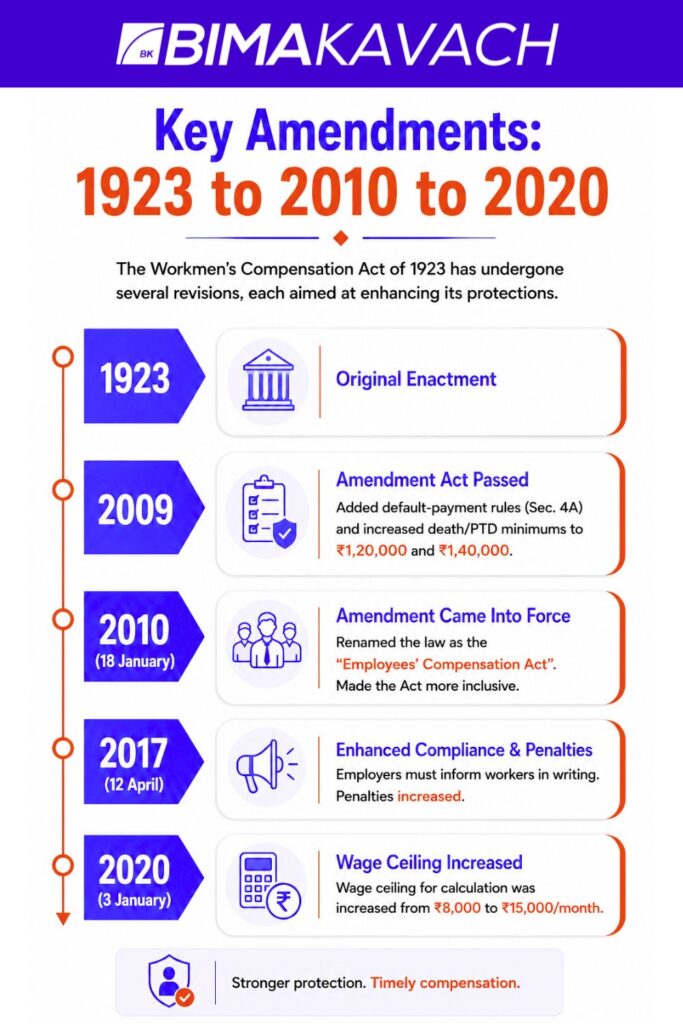
The proposed Social Security Code, 2020, aims to bring further integration of this Act with other labour laws, even though it has not been fully implemented across the country yet. To know about the current compensation formulas and minimum amounts in force today, refer to the table in section 5 above.
Who Does the WC Act Apply To?
The scope of the Workmen’s Compensation Act 1923 is defined by Schedule II, which lists the industries and occupations covered under the law. Any establishment employing 10 or more workers in a hazardous sector falls within this scope, regardless of how much an individual employee earns. There is no wage ceiling for eligibility itself.
Schedule II covers a wide range of industries and job roles, including:
- Factories and manufacturing units
- Mines and quarrying operations
- Plantations (tea, coffee, rubber, and similar estates)
- Construction sites and civil engineering works
- Transport undertakings, including road transport
- Railways and railway-allied operations
- Drivers, mechanics, and cleaners/helpers working with motor vehicles
- Crew members on board vessels and aircraft
- Dock workers and those engaged in loading/unloading operations
Not every worker is covered, though. Casual workers engaged outside the employer’s regular trade or business, along with members of the armed forces, also fall outside coverage. Besides, employees already protected under the ESI Act 1948 are excluded from the scope of the Workmen Compensation Act 1923, since their medical and disability benefits are handled through that separate scheme. In fact, employers must know the WC vs ESI distinction if they want to maximise the benefits offered by both these Acts.
What Does the WC Act Require From Employers?
Among the core features of the WC Act 1923 are a defined set of obligations every employer in a covered industry must meet. These rules spell out exactly when liability arises, when it doesn’t, and what workers are entitled to expect. Understanding all three is essential to staying compliant.
4a. When Are You Liable to Pay?
As an employer, you are liable to pay compensation through a no-fault, strict-liability framework. This means you, as an employer, are held accountable for compensating an injured employee regardless of whether you were negligent. The key point to consider here is whether the injury occurred “out of and in the course of employment.” It establishes a causal connection between the injury and the job. Besides workplace accidents, this also includes occupational diseases contracted during the course of employment.
The liability may not be limited to the factory gate alone. As per the doctrine of notional extension, accidents occurring just outside the premises or during commute can be covered if the journey is reasonably related to work.
4b. When Are You Not Liable?
Liability doesn’t apply in every situation. Typically, you will not be liable if the injury was due to the worker’s own self-inflicted act or deliberate misconduct or if the worker was intoxicated or under the influence of drugs at the time of the accident. Choosing to ignore the provided safety rules or safety devices for protection also removes liability. Moreover, compensation is not payable for non-fatal injuries if the resulting disablement lasts less than three days.
4c. What Rights Do Your Workers Have?
Besides your liability as an employer, workers themselves have specific rights under the Act. They are entitled to compensation for injury, occupational disease, or death arising out of employment. They must file their claim within two years of the accident. Workers also have the liberty to select their own medical practitioner for treatment and to appeal to the Commissioner for Workmen’s Compensation in case there is a dispute. In case of a worker’s death, dependents inherit the right to WC claim compensation on their behalf.
How Much Compensation Does the Act Require?
Compensation under the Workmen’s Compensation Act 1923 is calculated using the injured worker’s monthly wages, their age at the time of the accident, and the nature of the disability. The table below sets out the formula and statutory minimum for each scenario:
| Cause | Formula | Minimum Amount |
| Accidental Death | 50% of monthly wages × relevant factor | ₹1,20,000 |
| Permanent Total Disability (PTD) | 60% of monthly wages × relevant factor | ₹1,40,000 |
| Permanent Partial Disability (PPD) | % of earning capacity loss (Schedule I) × PTD amount | Varies by injury type |
| Temporary Disablement | 25% of monthly wages, paid fortnightly | Payable for the duration of disablement |
Here’s an important note on the relevant factor of workmen compensation act. The “relevant factor” used in the death and PTD/PPD formulas comes from Schedule IV, and it’s essentially an age-based multiplier. The younger the worker, the higher the factor, since a younger person has a longer remaining working life over which the loss is spread. This is why two workers earning identical wages can receive very different compensation amounts purely based on age at the time of the accident.
The relevant factor changes with age, and the percentage of wages used varies by injury type, so death, PTD, PPD, and TTD each work out differently in practice. You need to understand the workers’ compensation calculation and check the numbers for your own workforce.
One more detail worth noting: for calculation purposes, monthly wages are capped at ₹15,000 under the 2020 amendment, even if the worker’s actual salary is higher. This cap doesn’t affect eligibility. It only shows how the formula is applied.
Types of Disability Under the Act
Understanding partial and total disablement starts with knowing that the law recognises four distinct categories, each with its own definition and compensation
| Type | Definition | Compensation Basis |
| Temporary Total Disablement | The worker is wholly unable to perform any work for a limited period | 25% of monthly wages, paid fortnightly (see the section above) |
| Temporary Partial Disablement | A worker can perform some work, but at reduced capacity, for a limited period | Half-monthly payment based on loss of earning capacity |
| Permanent Total Disablement (Schedule I, Part I) | A worker permanently loses the ability to perform any work | 60% of monthly wages × relevant factor, or statutory minimum (see the section above) |
| Permanent Partial Disablement (Schedule I, Part II) | The worker permanently loses a portion of their earning capacity, as listed by injury type | Percentage of PTD amount, based on assessed loss |
Occupational Diseases Under the WC Act (Schedule III)
Apart from the provision made for workplace accidents, the Workmen’s Compensation Act 1923 also covers occupational diseases contracted in the course of employment. Schedule III of the Act specifies the list of diseases and the corresponding types of employment in which the diseases are considered compensable. Thus, such diseases are encompassed within the broader ambit of the Act. Common examples include silicosis among mining workers, lead poisoning in manufacturing roles, asbestosis from prolonged asbestos exposure, and noise-induced hearing loss for heavy machinery operators.
For these occupational diseases in Schedule III, “arising out of employment” is considered satisfied once the worker has been employed in the listed occupation for the stipulated minimum period. There is no need for further proof of causation. The employer’s liability will be similar to the case of accidental injury.
How Does a Worker File a Compensation Claim?
Filing a claim under the Workmen’s Compensation Act 1923 involves following a set legal sequence:
- Notify the employer: The injured employee (or the dependents, in case of death) must inform the employer in writing about the accident at the earliest.
- Employer reports to the Commissioner: The employer must report the accident to the Commissioner for Workmen’s Compensation within 7 days.
- File the claim: The worker or dependents submit a formal claim to the Commissioner.
- Medical examination: The worker is medically examined to determine the nature and extent of disablement.
- Commissioner determines compensation: The Commissioner determines the compensation amount, taking into account the evidence and the applicable formula.
Everything listed above should be completed within a strict time limit. The Act imposes a 2-year limitation period starting from the date of the accident (or death) for filing a WC compensation claim, after which the right to claim generally lapses.
In case of a dispute (over liability, the extent of disablement, or the amount of compensation), the matter is adjudicated by the Commissioner. He functions as a quasi-judicial authority for resolving such cases. If either of the parties is not satisfied with the Commissioner’s decision, they can appeal to the High Court, but only on substantial legal questions, not for a fresh fact-finding mission.
Employer Obligations and Penalties for Non-Compliance
Compliance under the Workmen’s Compensation Act is not all about paying compensation alone. Employers have various ongoing obligations to fulfil throughout the employment relationship.
Record-Keeping: Employers are obligated to maintain thorough and correct records for all workplace accidents and injuries, as they could be used for any compensatory claims or inspection in the future.
Reporting: In case of a death or major injury, the employer should report the incident to the Commissioner for Workmen’s Compensation. The Commissioner is responsible for adjudication and enforcement on behalf of the State Government.
Timely Payment: Under Section 4A, payment of compensation must be made within one month (30 days) of it becoming due. If this deadline is not met, simple interest at the rate of 12% per annum will be charged. Also, if the Commissioner considers the explanation provided to be unjustifiable, the employer shall be liable to pay a further penalty of up to 50% of the amount of compensation.
Workplace Notices: At the workplace, employers must display notices that explain the provisions of the Act, so that workers are aware of their rights.
Insurance: Let’s be precise here. The Act imposes liability on the employer. Insurance is merely the method employers use to fund that obligation. Insurance should not be seen as a substitute for the Act.
Notable Case Law
Judicial decisions have defined the practical application of the Workmen’s Compensation Act. Four important decisions highlight certain points employers should be aware of:
Indian Iron and Steel Co. v. Durgaprasad: The Court held that the Act is a social welfare measure (beneficial legislation) to protect workers. It further stated that its provisions should be interpreted liberally in favour of workers rather than be read narrowly.
Employer Takeaway: When a claim is borderline, courts generally tend to favour the employee’s version rather than that of the employer.
Parimal Chandra Raha v. LIC: The Court ruled that compensation should be based on the worker’s capacity to earn rather than the wages drawn at the time of the accident. Thus, the focus should be on the worker’s capability of earning had the injury not occurred.
Employer Takeaway: A recorded low salary cap may not limit your liability. The earning capacity is viewed through a much wider lens.
Indian Hume Pipe Co. v. Its Workmen: The Court ruled that compensation is payable only when a causal connection of the injury is established with the employment. It should satisfy both “arising out of” and “in the course of” employment.
Employer Takeaway: An injury without a real connection to the job cannot be compensated even if it occurs during working hours.
Mackinnon Mackenzie v. Ibrahim Mahmmed Issak: The Court accepted the doctrine of notional extension, under which an employer’s liability may go beyond the physical workplace if the worker is injured while reasonably approaching or leaving it.
Employer Takeaway: Your liability does not merely end at the door of your work premises.
How WC Insurance Helps Employers Manage This Liability
The Workmen’s Compensation Act imposes a statutory liability. Employers are legally bound to provide compensation even if they are not at fault. An insurance policy under the WC Act does not remove this liability. It simply transfers the financial risk from your business to an insurance company so that a single accident does not disrupt your cash flow.
A Workmen’s Compensation Insurance policy typically covers disbursement of compensation and also legal costs and medical expenses that arise in connection with a workmen’s compensation claim. If you want to learn more about coverage, premiums, and how to buy a WC Policy on the Bimakavach platform, get in touch with our experts. They will be more than happy to help you choose the best fit for your business.
Frequently Asked Questions
The key features of Workmen’s Compensation Act 1923 include no-fault employer liability, a set compensation schedule linked to wages and severity of injury, occupational disease coverage, a dedicated Commissioner for resolving disputes, and a 2-year window for submitting claims. In combination, these features constitute a structured, predictable system instead of individual cases of negligence claims.
The relevant factor of the Workmen’s Compensation Act is an age-driven multiplier listed in Schedule IV. It is used to calculate compensation for death and permanent disability. The younger the worker, the higher the factor. This reflects the greater number of working years lost. It’s then applied to a percentage of monthly wages to determine the final compensation payout.
The advantages of Workmen’s Compensation Act for employers include a pre-defined, limited liability framework instead of unpredictable common-law claims, a streamlined dispute resolution process instead of lengthy litigation, and the option to transfer financial risk entirely through WC insurance.
Yes. As per the entitlement details in the Act, permanent, temporary, contractual, and casual workers employed in Schedule II occupations are covered if the injury arises out of and in the course of employment. Also, there is no wage limit for eligibility.
Workers already covered under the ESI Act 1948 won’t be covered by the WC Act. ESI applies to establishments with more than 10 employees with wages up to ₹21,000/month. On the other hand, the WC Act covers workers outside this wage bracket and those in Schedule II industries. A full comparison of the WC Act vs ESIC would be helpful if your workforce is around the ₹21,000 threshold.
Yes. As per Section 4A, if an employer does not pay compensation within one month (30 days) after the due date, the Commissioner can order simple interest at 12% per annum. Additionally, a penalty of up to 50% of the compensation amount can be levied if the delay is not justified.