




Key Takeaways:
- A workers’ compensation claim can be filed by an injured employee, their dependents, or even the employer on their behalf.
- The WC policy claim process involves four distinct stages: incident reporting, documentation, insurer review, and settlement.
- For different claim types, different documents may be required. For example, medical records in case of injury claims, death certificates, and dependency proof for fatal claims.
- If employers file accurately and timely and also submit complete documents, they can avoid claim delays or rejections.
What Is a Workmen’s Compensation Claim?
A Workmen’s compensation claim is a formal request filed by an injured employee, or their dependents in case of death. It is filed for seeking compensation from the employer’s insurer for harm suffered during the course of employment.
This claim is filed under the Employees’ Compensation Act 1923 (formerly known as the Workmen’s Compensation Act). This Act sets the rules for employers’ responsibility for work-related injuries throughout India. It applies to injuries, disabilities (both permanent and temporary), occupational diseases, and death, as long as these arise out of and during the course of employment. The claim establishes the employee’s right to compensation and initiates the process of assessment and settlement by the employer and the insurer.
Step-by-Step WC Claim Process
Employers will find it easier to respond quickly and correctly when a workplace accident happens if they know the WC policy claim process thoroughly and step by step. Here’s how to claim workmen’s compensation, from the moment a covered incident occurs to final settlement.
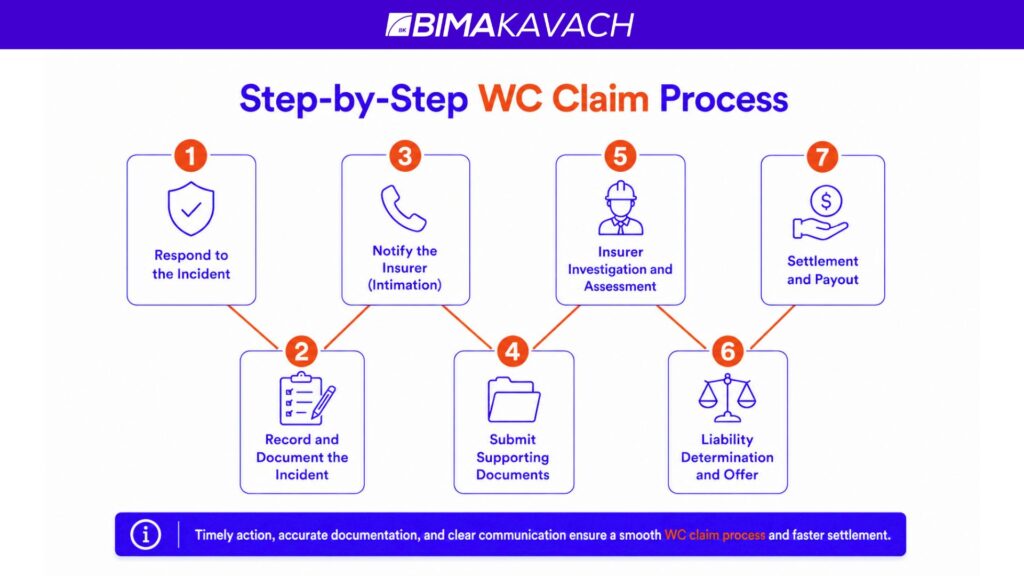
Step 1: Respond to the Incident
The safety and health of the injured employee must be your top priority. Make sure to secure the site to avoid any more injuries, arrange immediate medical attention, and ensure the employee is taken care of without delay. After the emergency measures are set in motion, make a note of the key facts of the accident, like the time and place, and the individuals involved, while everything is still fresh in your mind.
Step 2: Record and Document the Incident
All accidents at the workplace must be recorded in the organisation’s internal accident register, which is a statutory requirement under labour laws. Take photos of the site, equipment involved, and any visible injuries if it’s safe and appropriate to do so, and get the contact information of the witnesses who saw the accident. This record will act as the objective foundation for the entire workers’ compensation claim process. As it cannot be accurately re-created later, it should be carried out immediately.
Step 3: Notify the Insurer (Intimation)
After the incident has been documented, the employer must notify the insurance company by filing a claim notification under the WC policy. This is a formal notification that an accident happened and that a claim might follow. Timely intimation is highly essential here. Any delay in notifying the insurer can often lead to potential problems in the determination of liability and slow down the rest of the WC settlement process. Employers must look at this step as a matter of urgency rather than just another administrative task.
Step 4: Submit Supporting Documents
Now that the intimation has been filed, the next step is submitting the supporting documents that the insurance company needs to assess the claim. The exact document checklist varies based on whether it is an injury, disability, or death claim. You can refer to the documentation section later in this guide for the complete list by claim type. Submitting complete and correct documents at this phase prevents waste of time arising from unnecessary exchanges with the insurer.
Step 5: Insurer Investigation and Assessment
After the insurer receives the documents, they typically initiate an investigation to make sure that everything related to the claim is true. A visit from a surveyor to the accident location, a medical examination of the injury or disability, and a review to confirm liability lies with the employer can all be part of this process. Employers and employees must be responsive and must cooperate with the insurer’s inquiries, as it will make the assessment process easier and quicker.
Step 6: Liability Determination and Offer
Based on the investigation, the insurer decides whether or not the claim is valid and, if it is, comes up with a compensation offer. Now, the employer or the employee (or their dependents) can go through the proposal, ask questions, and even negotiate in case the evaluation doesn’t seem to be consistent with the facts, or accept it if it appears fair. This is the phase in the workers’ compensation claim process where liability and the amount of compensation are formally established.
Step 7: Settlement and Payout
After both liability and compensation amount have been decided upon, the insurance company processes the payout depending on the WC policy terms. Claim settlement timelines can vary depending on claim complexity, how correctly the documents were filed, and the insurer’s internal processes. Simple claims with complete paperwork usually result in smooth and quick disbursement. Therefore, getting the initial steps right is extremely important for a smooth WC settlement.
Documents Required to File a WC Claim
The exact documents required for a workers’ compensation claim depend on whether it involves an injury, disability, or death. Keeping ready the right claim form and proper supporting documents can significantly speed up the processing.
For Injury and Disability Claims
- Claim intimation form submitted to the insurer
- FIR/police report, if applicable to the incident
- A medical certificate from a doctor stating the extent of the injuries and details of the treatment records
- Salary slips/wage register of the affected employee
- Accident register entry from internal records
- Memorandum of Agreement (Form M), where liability and compensation are mutually agreed upon
For Fatal Accident Claims
- Death certificate of the deceased employee
- FIR filed with local authorities
- Postmortem report that confirms the cause of death
- Legal heir certificate identifying the dependents entitled to receive the payout
- The notice of accident causing death (Form A)
- Wage records of the deceased employee
- Statements from witnesses giving details of the incident
How Is Compensation Calculated?
Workers’ compensation settlement amounts are broadly categorised into death, permanent disability (total or partial), and temporary disability. The formula for calculating workers’ compensation in each category of claim depends on several factors, such as the worker’s monthly wage, age at the time of the accident, and the nature or extent of the disability. The Employees’ Compensation Act lays down the minimum compensation payouts for death and permanent total disability. This ensures a fundamental level of protection for the employees, regardless of other factors.
For compensation calculation, monthly wages are capped at Rs 15,000, and a multiplier factor depending upon the age is applied to reach the final compensation amount. However, the actual formulas vary by claim category and involve several other variables.
What Happens If Your WC Claim Is Rejected?
There are a few common reasons why a claim can be rejected. These may include a delay in the submission of intimation to the insurer, incomplete or missing documents, or a finding that the injury did not result from a work-related accident. Understanding the reason behind a rejection is the first step toward resolving it.
Steps to Take After Claim Rejection:
- Request written reasons for the rejection from the insurer to understand exactly where the claim fell short.
- Submit additional evidence or documentation that addresses the gaps identified in the rejection.
- Approach the Commissioner for Workmen’s Compensation if the dispute isn’t resolved directly with the insurer.
- Appeal to the High Court if the matter remains unresolved after the Commissioner’s decision.
Handling a rejected settlement can feel overwhelming at times. The seasoned experts at BimaKavach help employers understand potential dispute points and strengthen their case at each stage.
Employer Responsibilities During a WC Claim
Once an unfortunate workplace accident occurs, employers have particular roles to perform, which are different from general policy obligations. It helps to know which employers need a WC policy in the first place, since this can influence who carries these responsibilities. Here are certain important employer responsibilities during a WC claim:
- Provide medical assistance to the injured employee immediately, without waiting for claim formalities to start.
- Record the details of the incident in the accident register. It is a statutory requirement that will form the basis of the claim.
- Inform the insurance company immediately to avoid delays/complications during the processing of the claim.
- Cooperate fully with the investigation of the insurer (including surveyor visits and queries for clarification).
- Ensure the injured worker’s payroll and other employment records are up to date, as these details can directly affect the compensation calculation.
- Do not terminate the injured employee while their workmen’s compensation claim is being dealt with, as this can bring additional legal challenges and may complicate liability decisions.
Tips for Faster Claim Settlement
A smooth compensation settlement is not always about the process. Often, it matters more about preparation. Here are some practical tips to follow in this regard:
- Keep documents organised before a claim arises: Have your accident registers, wage records, and employee details ready in advance. This will save you critical response time when an unfortunate accident occurs.
- Inform the insurer the same day or the next day: The sooner the insurance company knows, the sooner they can initiate the assessment.
- Submit complete documentation in one go: Submitting incomplete documents is one of the most common causes of claims delay. Hence, double-check the documentation checklist before submission.
- Cooperate promptly with insurer queries: Answer clarification queries from the insurer quickly so that the ‘wheels of the claims process’ keep on moving smoothly.
- Use a platform like BimaKavach to handle insurer coordination: By letting a renowned platform compare the insurers and handle the communication on behalf of the employer can remove redundant and time-consuming follow-ups.
- Maintain a clean claims history: Generally, if there are no previous disputes and the claim history is clean enough, future claims may be processed swiftly.
Real-World WC Claim Scenarios
Scenario 1: Construction Site Fall (Temporary Disability)
A worker at a construction site fell from scaffolding and sustained a leg fracture that required hospitalisation and several weeks of recovery time. The employer informed the insurer of the incident within 24 hours. Then, supplied the insurer with medical reports and wage slips to support the WC claim. The insurer checked the documents and initiated the compensation payout process for temporary disability. The settlement eventually reached the worker, who covered his medical expenses and also wage loss incurred during the recovery. period.
Scenario 2: Factory Fatality (Death Claim)
A worker at a manufacturing unit was injured in an accident involving factory machinery and died after a couple of days. The employer immediately filed an FIR and submitted the death certificate along with the required Form A (the notice of accident causing death) to the insurer. The claim was investigated to ascertain the circumstances of the accident and establish liability. Based on the deceased worker’s wages and age factor, the settlement amount was paid out to the legal dependents.
How BimaKavach Helps with WC Claims
Going through the processes of a workers’ compensation claim may seem like a heavy burden on top of running a business. It is here that Team BimaKavach supports employers end-to-end, from claim intimation to final settlement. Beyond claims support, the platform also lets employers compare WC policies online across 25+ insurers, so the right cover is in place well before a claim ever arises.
Frequently Asked Questions
Both are eligible to file, but the claim is normally filed by the employer with the insurance company. In case the employer does not do so, the worker can go directly to the Commissioner for Workmen’s Compensation.
Such injuries are normally not covered. WC covers injuries arising out of and during employment. Commute injuries would not come under this category unless the employer provides the transport.
Yes, if the disease is included in Schedule III of the Act and arises out of and during employment. You may also need an occupational disease add-on.
Under the Employees’ Compensation Act, the employer’s liability is considered a no-fault liability. The Compensation is still to be paid even if the worker was partly negligent, as long as it is not a self-inflicted injury under the influence.
No. The Doctrine of Election limits your choice. As per this, you must choose between claiming under the Act or filing a civil suit for damages. You can’t avail both.
WC covers statutory compensation under the Act. On the other hand, employer liability insurance covers damages awarded by a court, beyond the limits of the Act. This is why a lot of employers purchase both to get maximum protection.
Not at all. The insurer that received the claims during the policy period will handle the same. Any subsequent switch or renewal will not have an effect.
Yes. BimaKavach lets you compare WC Insurance online with more than 25 insurers, buy online, and get end-to-end claim support from day one.