




Key Takeaways
- The workmen’s compensation calculation formula takes into account monthly wages (capped at ₹15,000), the relevant factor mentioned in Schedule IV, and injury percentage.
- Death compensation = 50% of wages × relevant factor, or ₹1,20,000 (whichever is higher). Additionally, ₹5,000 for funeral expenses.
- Permanent total disability = 60% of wages × relevant factor, or a minimum of ₹1,40,000.
- Temporary disability = 25% of wages fortnightly up to 5 years, after a 3-day waiting period.
This guide is intended to help employers, HR managers, and safety officers who seek clarity on the workmen’s compensation calculation formula when an injury or death occurs at the workplace. It explains the complete process of calculating workmen’s compensation and covers the Schedule IV relevant factor table. It also demonstrates certain real-life examples for death, disability, and injury claims. It will help you estimate WC claim settlement amounts accurately and remain compliant.
Let’s proceed!
What Is Workmen’s Compensation Insurance?
Workmen’s Compensation Insurance is governed by the Employees’ Compensation Act, 1923 (earlier known as the Workmen’s Compensation Act). It is designed to protect employees or their dependents financially in case of injury, disability, or death arising out of workplace-related incidents.
This Act mandates employers to compensate workers if they suffer physical injury or lose their lives during the course of employment. The legislation was enacted to secure the livelihood of workers who often operate in high-risk environments across industries such as construction, manufacturing, logistics, as well as in domestic jobs. Employers are legally bound to procure Workmen’s Compensation Insurance if they fall within the scope of the Workmen’s Compensation Act, 1923.
When Is Compensation Payable (and When Not)
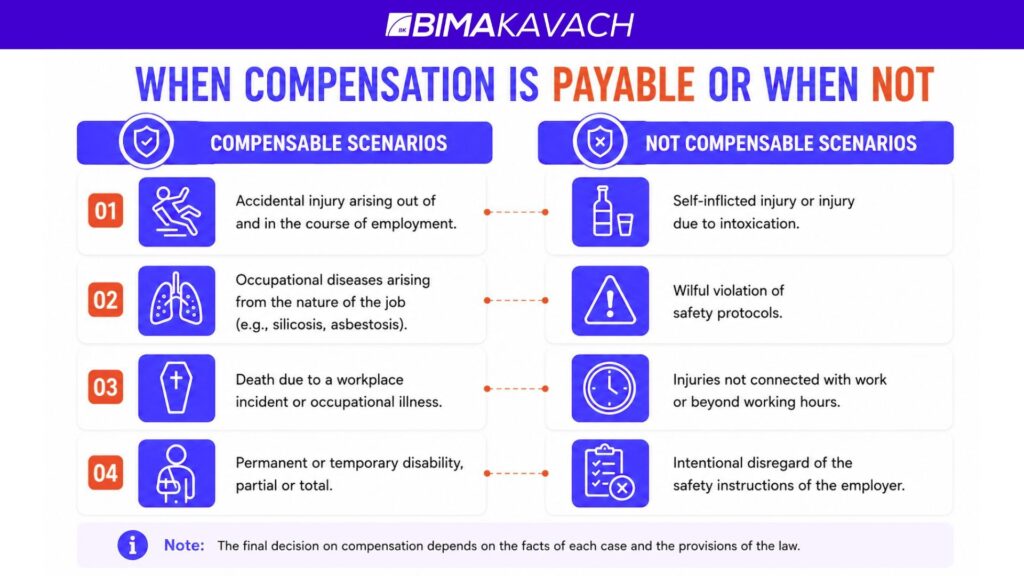
To summarise: Compensation is only paid when a direct, provable link of the injury can be established with employment duties.
Key Factors in Workmen Compensation Calculation
There is no fixed amount for workers, as the compensation payable is calculated based on four primary factors:
| Factor | What It Means for Workmen Compensation | Impact on Compensation |
| Nature of Injury | Whether the injury is temporary or permanent, and results in partial and total disablement, or death | Determines which formula and compensation slab applies |
| Age of Employee | The “relevant factor” (multiplier) under Schedule IV is multiplied with the actual age to calculate payout. Different factors are given for different age groups (young or old) | Directly increases or decreases the payout amount |
| Monthly Wages | Basic salary plus regular allowances (e.g., DA), excluding bonuses, reimbursements, and perks; capped at ₹15,000/month | Higher wages (up to the cap) mean higher compensation |
| Earning Capacity | Extent of income-earning ability lost, relevant in permanent partial disability (PPD) cases | Lower earning capacity loss reduces the payout percentage |
Two additional provisions are important here. In the event of an employee’s death, a fixed amount of ₹5,000 is paid, in addition to the compensation amount, to cover funeral expenses. Also, temporary disability payments are disbursed only after a 3-day consecutive waiting period.
WC Calculation Formula for Different Scenarios
| Scenario | Formula | Minimum Payable | Example Payout |
| Death | 50% × wages × Relevant Factor | ₹1,20,000 | ₹15,59,850 |
| Permanent Total Disability | 60% × wages × Relevant Factor | ₹1,40,000 | ₹17,73,540 |
| Permanent Partial Disability | 60% × wages × Relevant Factor × disability % | Proportionate to loss | ₹6,63,013 |
| Temporary Disability | 25% of wages, paid fortnightly | – | Ongoing, up to 5 years |
How to Calculate Workmen Compensation in Case of Death
Death Compensation = 50% × Monthly Wages (capped at ₹15,000) × Relevant Factor, or ₹1,20,000 , whichever is higher, additional ₹5,000 for funeral expenses
This is the core of the WC death claim calculation under the Act. The Act also provides a full breakdown of employees’ compensation entitlements in India and related benefits.
Example: Rajan, a 30-year-old construction worker earning ₹18,000/month, dies in a scaffolding collapse.
- Identify wages: ₹18,000/month
- Apply the ₹15,000 wage cap: ₹15,000 considered
- Look up Relevant Factor for age 30: 207.98
- Apply formula: 50% × ₹15,000 × 207.98 = ₹15,59,850
- Compare with minimum ₹1,20,000: ₹15,59,850 is higher, so this is payable
Rajan’s legal nominee/dependent receives ₹15,59,850 and ₹5,000 for funeral expenses.
Compensation for Permanent Total Disability (PTD)
PTD Compensation = 60% × Monthly Wages (capped at ₹15,000) × Relevant Factor, or ₹1,40,000, whichever is higher
Example: Meena, 35, loses both hands in a press machine accident.
- Identify wages: capped at ₹15,000/month
- Look up Relevant Factor for age 35: 197.06
- Apply formula: 60% × ₹15,000 × 197.06 = ₹17,73,540
- Compare with minimum ₹1,40,000, and ₹17,73,540 is higher.
Hence, Meena receives ₹17,73,540 as per the WC compensation calculation.
Compensation for Permanent Partial Disability (PPD)
The Act divides permanent partial disability (PPD) into two categories: Schedule I and non-scheduled injuries.
For Schedule I injuries, a fixed loss percentage (e.g., loss of one eye = 40%) is prescribed by the Act.
For non-scheduled injuries, the loss percentage is determined through a medical assessment. This distinction exists because certain types of injuries have predictable, documented impacts on earning capacity, while some others can vary from one case to another.
PPD Compensation = 60% × Monthly Wages × Relevant Factor × Disability %
Example: Farhan, a factory worker, loses one eye in a chemical splash accident
- Injury: loss of one eye (40% disability)
- Age: 40
- Relevant Factor: 184.17
- Compensation = 60% × ₹15,000 × 184.17 × 40% = ₹6,63,012.6
Therefore, Farhan receives ₹6,63,012.6 in PPD compensation
Compensation for Temporary Disability
Temporary Disability Compensation = 25% of Monthly Wages, paid every fortnight
For WC claim calculation in temporary disability cases, a 3-day consecutive waiting period is applicable before payment is processed. If the disability lasts 28 days or more, the compensation payment starts retroactively from the 16th day of disability. Payments continue until recovery or for a maximum of 5 years (whichever comes first), subject to certification by a registered medical practitioner.
Schedule IV: Relevant Factor Table for WC Calculation
The relevant factor depends on the employee’s completed age on their last birthday before the date on which compensation is due.
| Age (In Years) | Factor | Age (In Years) | Factor |
| Up to 16 | 228.54 | 41 | 181.37 |
| 17 | 227.49 | 42 | 178.49 |
| 18 | 226.38 | 43 | 175.54 |
| 19 | 225.22 | 44 | 172.52 |
| 20 | 224.00 | 45 | 169.44 |
| 21 | 222.71 | 46 | 166.29 |
| 22 | 221.37 | 47 | 163.07 |
| 23 | 219.95 | 48 | 159.80 |
| 24 | 218.47 | 49 | 156.47 |
| 25 | 216.91 | 50 | 153.09 |
| 26 | 215.28 | 51 | 149.67 |
| 27 | 213.57 | 52 | 146.20 |
| 28 | 211.79 | 53 | 142.68 |
| 29 | 209.92 | 54 | 139.13 |
| 30 | 207.98 | 55 | 135.56 |
| 31 | 205.98 | 56 | 131.95 |
| 32 | 203.85 | 57 | 128.33 |
| 33 | 201.66 | 58 | 124.70 |
| 34 | 199.40 | 59 | 121.05 |
| 35 | 197.06 | 60 | 117.41 |
| 36 | 194.64 | 61 | 113.77 |
| 37 | 192.14 | 62 | 110.14 |
| 38 | 189.56 | 63 | 106.52 |
| 39 | 186.90 | 64 | 102.93 |
| 40 | 184.17 | 65 or more | 99.37 |
Real-World Calculation Examples
Now that you have understood how to calculate employee wages for WC policy, here are some examples to show the application of the workmen’s compensation calculation formula to real scenarios.
Case 1: Death Due to Electric Shock
- Name & job description: Suresh, an electrician at a manufacturing unit
- Age: 28 years
- Monthly wage (capped): ₹15,000
- Relevant Factor: 213.57
Using the death compensation formula: ₹7,500 × 213.57
Final Amount: ₹16,01,775 (plus ₹5,000 funeral expenses)
Case 2: Permanent Total Disability
- Name & job description: Vikram, a machine operator injured on the shop floor
- Age: 40 years
- Monthly wage (capped): ₹15,000
- Relevant Factor: 184.17
Using the PTD formula: ₹9,000 × 184.17
Final Amount: ₹16,57,530
Case 3: Loss of Index Finger (Partial Disability)
- Name & job description: Anita, a warehouse worker
- Disability % (Schedule I): 14%
- Monthly wage (capped): ₹15,000
- Age: 45 years
- Relevant Factor: 169.44
Using the PPD formula: ₹9,000 × 169.44 × 0.14
Final Amount: ₹2,13,891.36
These cases show how substantial payouts can be, even for partial loss.
How to File a Workmen Compensation Claim
Understanding how to calculate workmen compensation is only ‘half the job done’. One also needs to follow a legal and time-bound process to claim the amount. Here are the important steps of the WC claim calculation process:
- Intimation to Employer: The employee or his/her dependents have to inform their employer about the incident immediately after it occurs. Delayed reporting can complicate the claims process and can also make it difficult to receive proper compensation.
- Filing a Claim: The claim has to be filed with the Commissioner for Workmen’s Compensation, accompanied by medical certificates, wage records, and proof of employment. At this stage, proper and complete documentation can directly contribute to faster processing of the claim and the payment.
- Investigation and Hearing: The Commissioner may conduct hearings, cross-examine evidence, and ascertain the appropriate compensation amount. Both the employer and the employee (or their families) can present their points during this stage.
- Payment: Once the Commissioner awards compensation, the employer/insurer must make payment within 30 days. If this deadline is missed, the employer can be subjected to interest and penal charges as per the relevant provisions of the Act.
This was only a snapshot of the complete WC claim settlement process. It can be quite complex at times, and there may be certain challenges employers face in managing WC claims.
Employer’s Liability and Penalties for Non-Compliance
Failing to comply with the Act can lead to grave consequences:
- Interest @ 12% per annum is levied if compensation is not paid to employees on time.
- Penal damages up to 50% of the compensation amount
- Civil/criminal liability circumstances in individual cases.
Employers need to:
- Purchase valid Workmen’s Compensation Insurance
- Maintain accurate wage records of the workers
- Provide a safe working environment and workplace safety instructions to employees
Non-compliance not only invites legal troubles but also tarnishes the company’s reputation. Hence, there should be no confusion about why every employer needs a WC policy.
Importance of Accurate Wage Documentation for WC Claims
Accurate wage records form the basis of any WC compensation calculation. You should have a proper understanding of how to calculate employee wages for a WC policy. Here is a full breakdown of what counts.
| Included in Monthly Wages | Not Included |
| Basic salary | Bonuses |
| Dearness Allowance (DA), House Rent Allowance (HRA) | Travel allowances |
| Overtime (if paid regularly) | Irregular, non-contractual perks |
Common Disputes:
- Underreported wages to lower the compensation payments
- Leaving out fixed allowances such as DA or HRA from the wage calculation
- Discrepancies or absence of age documentation leading to wrong calculation of the age-based relevant factor
To avoid these disputes when learning how to calculate workmen compensation, maintain signed salary slips for every employee, record DA/HRA separately from other income such as bonuses and reimbursements, and document overtime patterns to establish regularity.
Note: Even if an employee’s actual salary exceeds ₹15,000, only ₹15,000 is used in the calculation. However, complete wage records are necessary because they can be a decisive factor when resolving disagreements about the rightful amount at a quicker pace.
Recent Judicial Trends and Amendments
Courts throughout India have demonstrated a progressive approach while delivering judgements in several recent cases:
- The definition of “accident” has been extended to include situations such as heart attack or stroke that can be attributed to job stress, over-exertion or other job-related causes.
- Mental trauma and long-term psychiatric injuries ( if their medical linkage can be established) are also brought within its ambit.
- The Courts have repeatedly held that inability to earn in the same capacity qualifies as disablement.
Recent Amendments:
- Higher compensation and salary ceiling limits have been set as compensation thresholds
- Facilitating the payment of compensation directly to the injured through digital channels to ensure quicker payment
- Tightening of the dispute resolution timelines
This move showcases India’s continued efforts and commitment to meet international standards of worker protection and health and safety in the workplace.
How BimaKavach Helps with Workmen’s Compensation Insurance
Having a clear idea of the workmen’s compensation calculation formula is only the first step. Ensuring your business has the right WC Policy in place is the next important one. BimaKavach has streamlined the second step so that employers aren’t left calculating compensation payouts without an insurance policy to back them. In the AI-powered Bimakavach platform, you can:
- Compare WC insurance quotes from 25+ insurers within minutes
- Get customised recommendations catered to your industry risk profile and workforce size
- Dedicated and end-to-end claims support, from documentation to settlement
FAQs on Workmen Compensation Calculation
What is the Workmen Compensation Calculation formula in India?
The workmen compensation calculation formula uses monthly wages (capped at ₹15,000), an age-based relevant factor provided in Schedule IV, and the nature of injury to determine compensation payouts related to death, disability, or injury.
How is Workmen’s Compensation calculated in case of death?
The WC death claim calculation is calculated as: 50% of monthly wages × relevant factor, or ₹1,20,000, whichever is higher. The amount is paid to the legal dependents of the deceased worker. An additional amount of ₹5,000 is provided to cover the funeral expenses.
What is the maximum monthly wage used for WC calculation?
Even when the actual salary of the employee is higher, the calculation of Workmen’s Compensation is based on the fixed monthly wage limit of ₹15,000. This is as per the Employees’ Compensation Act, 1923.
How much compensation is payable for permanent total disability?
Permanent total disability compensation is equal to 60% of monthly wages × relevant factor. However, a minimum amount of ₹1,40,000 is paid if the calculated amount is lower.
What is the minimum compensation under the WC Act?
As per the WC Compensation calculation, the minimum death compensation under the WC Act is ₹1,20,000 and ₹1,40,000 for permanent total disability.
How is compensation calculated for permanent partial disability?
Permanent partial disability compensation is equal to 60% of wages × relevant factor × disability percentage, based on Schedule I for listed injuries or medical assessment for others.
What is the 3-day waiting period for temporary disability?
Temporary disability payments are provided if the disability or injury persists for a minimum of 3 consecutive days. Compensation is not provided for trivial injuries.
Are funeral expenses covered under Workmen’s Compensation?
Yes. An amount of ₹5,000 can be paid to cover funeral expenses, in addition to the death compensation amount as part of standard WC claim calculation under the Act.
Does the employer pay compensation or the insurer?
By law, the employer is liable to pay compensation. However, if the employer is covered under a Workmen’s Compensation Insurance policy, the insurer either reimburses the employer for the payout or directly settles the claim.
Conclusion
The workmen’s compensation calculation formula is a systematic way of balancing and determining statutory compensation. It considers wages, age, and injury type to ensure fair, timely, and legally mandated payouts for employees and their dependent family members. For employers, applying this formula correctly is not simply about ensuring compliance. Rather, it’s about carrying out one’s duty of care when workers are in dire need of timely support. Although workplace hazards cannot be eliminated, correct calculations, combined with the right WC policy from BimaKavach, can transform a crisis into a manageable recovery.