




Running a business in India involves a plethora of compliance requirements, and ESIC registration undoubtedly is the first priority for any employer with a large workforce. However, it is surprising that many business owners still consider it as the last thing to do – just something to deal with when an inspector arrives. The problem with such an approach is that it’s legally risky and strategically short-sighted.
The Employees’ State Insurance Corporation or ESIC, governed by the ESI Act of 1948, is among the most far-reaching social security schemes in India. For businesses, timely esic employer registration is not merely a matter of avoiding penalties. Rather, it’s more about building a sustainable working environment where employees are secured and their wellbeing is a priority.
Whether you are starting your own business, growing a mid-sized company, or running an established enterprise, this handbook will educate you on all the aspects: what ESIC registration is, who qualifies, what the esic registration benefits are and exactly which documents are required. Above all, we will walk you through the esic registration process with a step-by-step guide.
Let’s start our journey with the basics!
________________________________________________________________________________________________
Key Takeaways:
- ESIC registration is mandatory for businesses with 10+ employees (20 in some states) where employees earn up to ₹21,000 per month.
- The ESIC online registration can be done through the ESIC portal. It generates a 17-digit employer code that can be used for all ESI compliance activities.
- Both employers and employees contribute monthly to fund medical care, insurance, and social security benefits under the ESI Act, 1948.
- Key esic registration benefits include medical treatment, sickness pay, maternity benefits, disability compensation, and dependants’ pensions.
- Employers must complete ESIC registration within 15 days of crossing the employee threshold.
- Documents required typically include PAN, incorporation/establishment certificate, employee details, bank information, and DSC for the authorized signatory.
________________________________________________________________________________________________
What Is ESIC Registration?
In the ESIC registration process, a business entity formally enrolls itself under the Employees’ State Insurance Act, 1948. ESIC registration makes the business liable to make monthly contributions for its employees’ medical and social welfare. ESIC, an autonomous body under the Ministry of Labour and Employment, Government of India, is responsible for running the scheme.
ESIC is basically a self-financing social security and health insurance scheme. The employer and employee share a fixed percentage of wages as their contributions every month. After that, the employees who are covered along with their families have the right to avail the benefits like free medical treatment in the ESI hospitals and cash compensation in case of sickness or disability.
There is a big difference between ESIC registration and ESI compliance. ESIC online registration is the very first step when you get onboard. Compliance is the second step which is an ongoing obligation where you have to pay your monthly contributions, file returns, and keep up with the record maintenance. You can’t ignore any of these processes.
How To Apply for ESIC Registration Online: A Step-by-Step Guide
The ESIC registration process has been fully digitized and is now can be done through the official ESIC portal .If this is your first time using the site, this detailed guide will help you understand the steps so that the procedure shall be very simple for you.
Step 1 — Visit the ESIC Portal
Open your browser and navigate to the employer login page in the ESIC official portal.
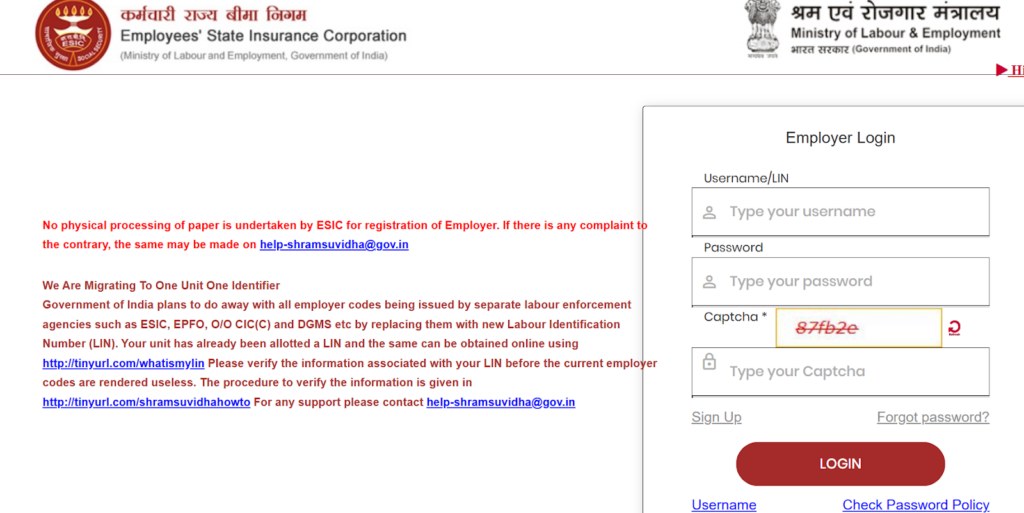
If you are a new employer, click on ‘Sign Up’ link and start the esic new registration process.
Step 2 — Provide the Preliminary Employer Details
Provide your company name, type of establishment, state, district, and the nature of business. Also provide a valid mobile number and email ID. These will be used for OTP verification and future communications related to your esic registration certificate.
Step 3 — Provide Establishment Information
Please provide the full address of the establishment, the date when the business was started, the total number of employees that are presently on the rolls, and the date on which the number of employees first crossed the eligibility threshold. Make no compromise with accuracy here . Discrepancies, if any, can invite compliance complications later on.
Step 4 — Add Employee Details
This is the stage of esic online registration at which most of your time and effort will be concentrated. In case of an employee whose salary is Rs. 21,000 or less a month, you will need to provide his/her name, position, date of joining, total monthly salary, Aadhaar number, and bank account information. This information will form the very basis of the ESI scheme for your workforce.
Step 5 — Upload the Supporting Documents
Upload the scanned copies of all documents required ( details are provided in a subsequent section). Verify that each document is clear and the file size is as per the specified requirements. A poor-quality scan is one of the most common reasons for delays in the esic online registration process.
Step 6 — Review and Submit the Application
Do a thorough check of all the data you have entered, before submitting it finally. Post submission, if you want to make some changes, it might be a bit complicated. If you want to check the employer details, employee data, and uploaded documents for one last time, you can use the ‘preview’ option on the portal.
Step 7 — Receive the ESIC Registration Certificate
Upon successful submission, the ESIC platform will provide a unique 17-digit employer code. This code is basically your ESIC registration certificate and is the main reference for all future interactions with the ESI Corporation. You can use it for contribution payments, submission of returns, and the generation of employee cards. Make sure to download esic registration certificate and keep it securely.
Who Needs to Do ESIC Employer Registration?
Not every business needs to register. The ESI Act lays out specific applicability criteria that determine whether your establishment falls within its ambit.
In most states, ESIC registration becomes mandatory for any establishment employing 10 or more persons. In a handful of states, this threshold is set at 20 or more employees. The employees must be earning a gross wage of up to Rs. 21,000 per month to be covered under the scheme. For employees with disabilities, this wage ceiling is extended to Rs. 25,000 per month.
The types of establishments covered under the ESI Act span a wide range:
• Factories and manufacturing units
• Shops, retail and wholesale establishments
• Hotels, restaurants, and road-motor transport undertakings
• Cinemas and newspaper establishments
• Private medical and educational institutions
• IT companies and BPO firms in notified areas
Once an establishment crosses the threshold, registration becomes obligatory within 15 days. It is also worth noting that once covered, an establishment remains under the ESI Act even if the employee count subsequently dips below the threshold — a provision many employers overlook until it is too late.
Key ESIC Registration Benefits for Employers
There is a tendency in the business community to view compliance as a cost center. ESIC registration, however, offers tangible returns that go well beyond legal protection.
First and most obviously, ESIC new registration shields your business from serious legal consequences. Non-compliance under the ESI Act can invite penalties under Section 85, including fines, prosecution, and even imprisonment in extreme cases. The cost of non-compliance almost always exceeds the cost of complying.
Second, the ESI scheme significantly reduces the employer’s burden when it comes to employee healthcare. Since covered employees and their dependents receive medical care through the ESI network, businesses are not expected to independently finance every health emergency that affects their workforce. This is a particularly meaningful benefit for small and medium-sized enterprises.
Third, ESI contributions made by the employer qualify for deductions under the Income Tax Act, offering a meaningful reduction in taxable business income. Combined with reduced attrition — because employees genuinely value social security coverage — the financial arithmetic starts to make a compelling case.
Fourth, and often underestimated, is the reputational dividend. Companies with clean compliance records tend to fare better in government procurement processes, corporate vendor audits, and even during investor due diligence. ESIC registration is increasingly a baseline expectation, not a differentiator.
ESIC Registration Benefits for Your Workforce
Understanding what the ESI scheme offers employees is not just HR knowledge — it is a powerful tool for workforce communication and retention. When your team knows what they are covered for, their confidence in the organization grows.
The range of benefits under the ESI scheme is genuinely extensive. Employees enrolled under the scheme receive:
• Medical benefits: Comprehensive healthcare for the insured person and their family, including outpatient, inpatient, specialist treatment, and medicines, through ESI dispensaries and hospitals.
• Sickness benefit: Cash compensation at 70% of daily wages for up to 91 days per year during certified illness.
• Extended sickness benefit: For long-term ailments like tuberculosis, malignancy, and other specified conditions, compensation can extend up to two years.
• Maternity benefit: Fully paid maternity leave for 26 weeks, which is fully funded through the ESI corpus.
• Disablement benefit: 90% of daily wages paid for temporary or permanent disablement arising from a work-related injury or disease.
• Dependants’ benefit: Monthly pension paid to the family of an insured worker who dies due to an employment injury.
• Funeral expenses: A lump sum payment of Rs. 15,000 to cover funeral costs in the event of the insured worker’s death.
• Unemployment allowance: Under the Rajiv Gandhi Shramik Kalyan Yojana, employees rendered unemployed due to closure, retrenchment, or permanent invalidity are entitled to an allowance for up to 24 months.
Complete List of Documents Required for ESIC New Registration
Gathering the right documents before you begin the ESIC online registration process saves enormous time and prevents avoidable rejections. Here is the complete and accurate list of documents required:
• Certificate of Incorporation (for companies) / Partnership Deed (for partnership firms) / Shop and Establishment Certificate (for shops and commercial establishments)
• PAN Card of the business entity
• Address proof of the establishment — utility bill, rent agreement, or property tax receipt
• Memorandum and Articles of Association (for private/public limited companies)
• A complete list of all employees, with details of designation, date of joining, and gross salary
• Bank account details of the establishment, along with a cancelled cheque
• Digital Signature Certificate (DSC) of the authorized signatory — Class II or Class III
• Aadhaar card and bank account details of each employee to be enrolled
• GST registration certificate, if applicable
• Employee attendance and wage records for the preceding period
Ensure that all documents are scanned clearly in the required format (usually PDF or JPEG) before starting the esic registration process at the official portal. Incomplete document submission is one of the most common reasons for delays in processing.
Wrapping it Up
All businesses that come under the purview of the ESI Act have a legal and ethical obligation to carry out ESIC employer registration without any delay. Once understood clearly, the esic registration process is not complicated and time-consuming. The entire process has been made fully digitized and streamlined.
The ESIC registration certificate you receive after successful completion of the process is not a mere compliance document. Rather, it is a demonstration to your employees that the company is concerned with their welfare.
If you are yet to start the process of ESIC new registration for your company, do not wait any further. Check if you are eligible, get your papers ready, and do the ESIC online registration today.