




Key Takeaways:
- Commercial General Liability Insurance coverage protects businesses against third-party bodily injury, property damage, and related legal costs.
- A CGL Policy is essential for businesses with customer footfall, on-site operations, products, or third-party interactions.
- Core CGL Insurance coverage includes bodily injury, property damage, product liability, completed operations, and legal defence expenses.
- CGL insurance exclusions include professional negligence, employee injuries, cyber risks, pollution, and intentional acts.
- Add-ons help customise a CGL insurance policy to address contractual, tenant, worldwide, and advertising-related risks.
- Choosing the right coverage limits and understanding exclusions is critical to avoid claim gaps and financial exposure.
Running a business these days is like walking through a field full of ‘landmines’ and third-party risks can be no less than these. A customer falling down in your office, causing accidental damage to a client’s property, or a product related injury claim may very quickly turn into an expensive legal mess. This is why Commercial General Liability Insurance coverage can be a fundamental risk management tool for businesses of any size.
Usually known as a CGL Policy, this insurance policy is a way to protect businesses from financial losses due to third-party claims resulting from the normal course of business activities. It provides comprehensive protection alright, but it does not mean that the coverage is not without its fair share of limits. It is very important to know the exact coverages and exclusions before you rely on a CGL insurance policy as your primary defense.
Before going into the coverages and exclusions, let’s have a brief understanding of what Commercial General Liability Insurance is.
What Is Commercial General Liability Insurance?
Commercial general liability insurance india is a business liability policy that covers legal liabilities arising from bodily injury, property damage, and legal costs caused to third parties during business operations.
Simply put, if a business is held legally responsible for causing harm to a third party (that could be a customer, vendor, or visitor), the CGL Policy is the one to cover compensation and defence costs.
In essence, commercial general liability insurance India is becoming a more significant consideration in the light of factors such as higher litigation awareness, stringent contracts, and increasing customer expectations. It is not uncommon for vendors, landlords, and clients to insist on a valid commercial general liability insurance india policy before entering into commercial agreements.
Key Commercial General Liability Insurance Coverage Areas
Before purchasing or renewing a CGL insurance policy, it is crucial to have a thorough understanding of the coverage inclusions-
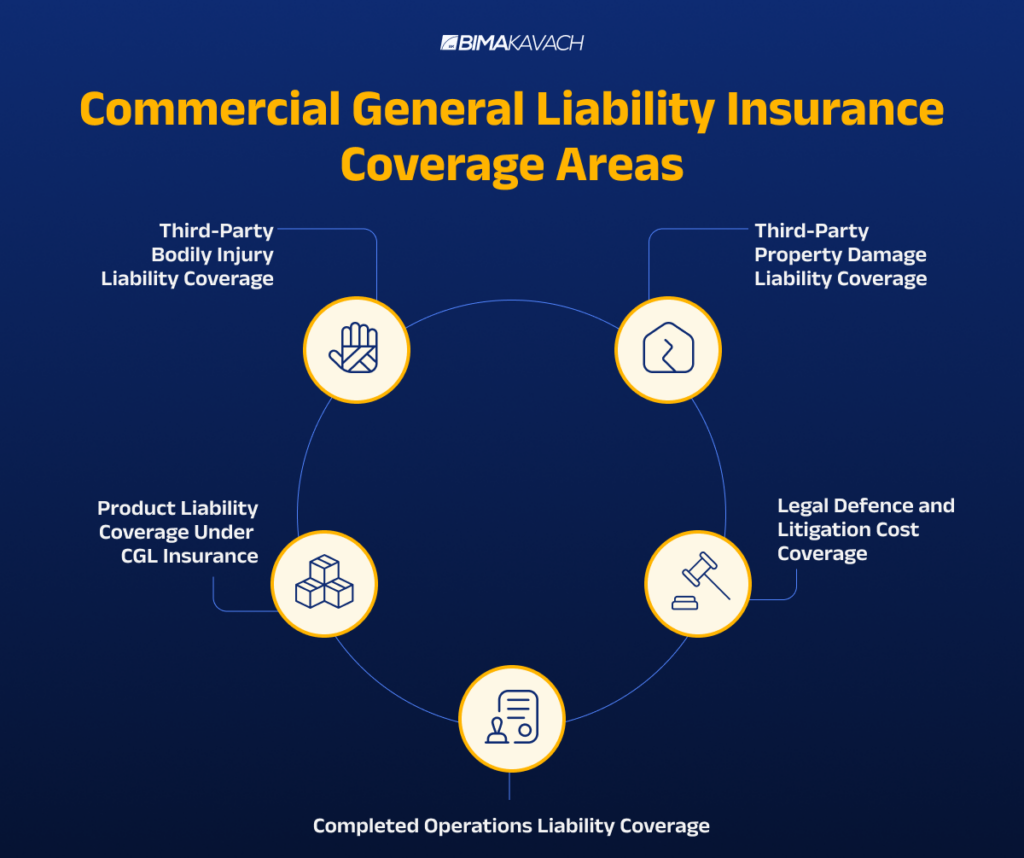
Third-Party Bodily Injury Liability Coverage
The bodily injury cover is one of the most vital parts of the Commercial General Liability Insurance coverage. It shields business financially from claims resulting from physical injuries sustained by a third party due to the business activities of the insured.
For example:
- A customer slips and falls at your office or store
- A visitor is injured during a site visit
- A vendor is hurt due to unsafe premises
The commercial general liability insurance india policy covers medical expenses, compensation awarded by courts, and legal defence costs.
Third-Party Property Damage Liability Coverage
Businesses often operate in shared or client-owned spaces. Accidental damage to third-party property can result in substantial claims.
A CGL Policy provides property damage coverage for:
- Damage to client premises during service delivery
- Accidental damage caused by employees or contractors
- Property damage arising from routine operations
This protection is especially relevant for contractors, service providers, and manufacturing units.
Product Liability Coverage Under CGL Insurance
If your business is involved in the manufacturing, distribution, or selling of products, product liability is probably the most significant risk factor. Lawsuits, product recalls, and damage to the company’s image are some of the consequences of injuries or damages caused by defective products.
Apart from a few exceptions, commercial general liability insurance coverage normally covers product liability, which means it protects the insured against:
- Bodily injury caused by defective products
- Damage to a property arising from a product failure
However, it should be kept in mind that the extent of cover differs from one insurer to another, and the limits should be thoroughly examined.
Completed Operations Liability Coverage
We often observe that, following the completion of a job or the delivery of services, many claims are filed. In such scenarios, completed operations liability can come to the picture.
A CGL insurance policy provides coverage for claims that may arise:
- After the completion of construction works
- Post-installation or post-repair
- After service delivery
This commercial general liability insurance coverage is vital for contractors, engineers, installers, and project-based businesses.
Legal Defence and Litigation Cost Coverage
Even baseless or exaggerated claims can lead to heavy legal expenses. One of the most valuable aspects of Commercial General Liability Insurance coverage is that it includes legal defence costs.
This typically covers:
- Lawyer / advocate fees
- Court expenses
- Expenses related to settlement negotiation
In many cases, defence costs alone can exceed the actual compensation amount. This shows the importance of this coverage.
What is Not Covered Under a CGL Policy? ( CGL Insurance Exclusions)
In the section above, we have seen that a CGL Policy provides broad protection. However, it may not cover every single risk that you may face. Knowing the exclusions will definitely be very helpful to you in preventing situations where the insurance company suddenly refuses to pay a claim that you thought was covered. Here are some coverage exclusions you should be aware of:
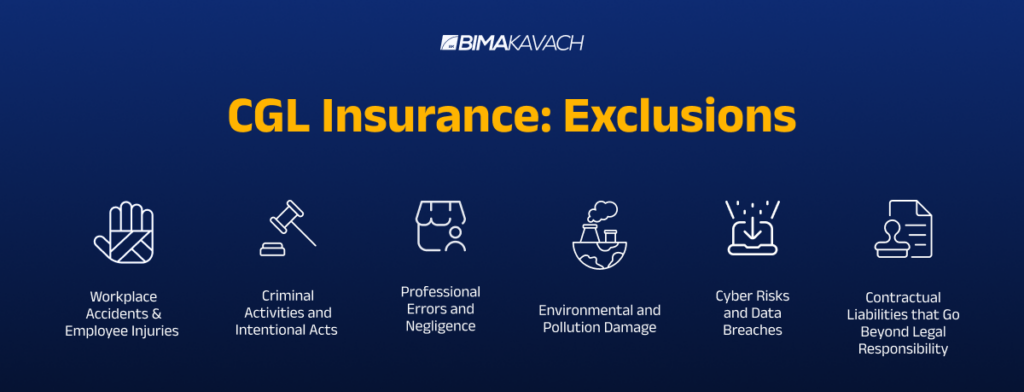
Professional Errors and Negligence
Claims arising from providing professional advice, design errors, or service mistakes are excluded from coverage. One needs a different Professional Indemnity insurance policy to take care of such claims.
For example, if a consultant gives wrong advice or an architect makes a mistake, a Commercial General Liability Insurance Policy will not cover it.
Workplace Accidents & Employee Injuries
Injuries that employees suffer in the course of their employment are not covered by a CGL insurance policy. Indian law requires that such risks should be covered by Workmen’s Compensation or Employee Compensation Insurance.
Criminal Activities and Intentional Acts
It is a standard practice in the industry that any kind of damage or injury that has been caused deliberately, through criminal behavior or fraud is not covered. Insurance is never there to support people who have committed intentional wrongdoing.
Contractual Liabilities that Go Beyond Legal Responsibility
Typically, insurance companies exclude liabilities that are assumed solely through contracts and where no negligence exists. This exclusion does not, however, apply in the case of a policy endorsement.
Cyber Risks and Data Breaches
In this age of digital revolution, most businesses tend to believe that cyber risk is part of the CGL policy coverage. However, a standard Commercial General Liability Insurance does not cover claims related to data breaches, hacking, and privacy violations, unless stated otherwise. Such cases require a separate Cyber Insurance policy.
Environmental and Pollution Damage
Environmental liabilities, pollution, and contamination-related claims are mostly excluded. This is because these issues generally have a high degree of severity, and their effects last for a very long time.
Commercial General Liability Insurance Coverage: Add-ons
Even though a standard Commercial General Liability Insurance coverage covers a wide range of risks, many businesses decide to have add ons to their policies in order to cover certain specific risks associated with their operations.These extensions enhance a CGL Policy by closing the most vital coverage gaps and personalising protection to the type and size of the business.
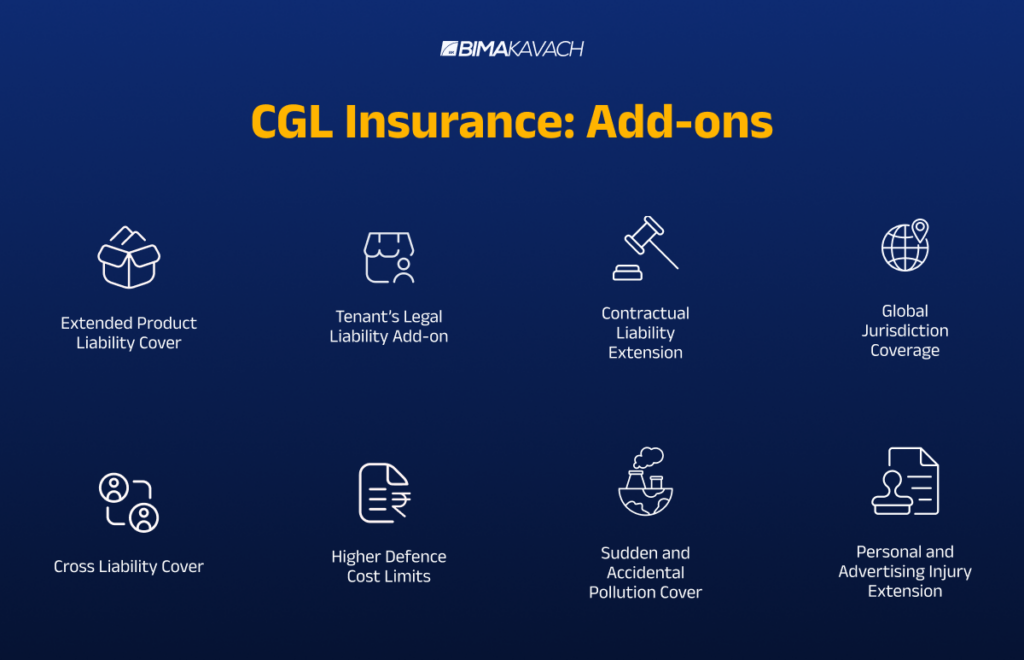
- Extended Product Liability Cover
It provides additional protection of product claims with higher value, long-tail liabilities, and jurisdiction specific legal costs, which is especially beneficial to manufacturers and distributors. - Tenant’s Legal Liability Add-on
It covers situations when tenants accidentally damage the leased or rented premises, which is generally excluded from the property damage sections of a standard CGL insurance policy. - Contractual Liability Extension
It indemnifies contractual liabilities, which can be helpful in meeting the client or vendor insurance requirements. - Global Jurisdiction Coverage
It offers coverage outside India for businesses that have overseas clients, export goods, or have international operations. However, it is subject to policy terms. - Cross Liability Cover
Recognises each insured as a separate legal entity, and so allows claims between group companies or partners under the same CGL Policy. - Personal and Advertising Injury Extension
Provides coverage for defamation, libel, slander, and copyright infringement arising from advertising or marketing activities. - Sudden and Accidental Pollution Cover
Offers limited coverage for unexpected pollution incidents, suitable for manufacturing and industrial businesses. - Higher Defence Cost Limits
Increases the sub-limits for legal defence expenses, which can be crucial in prolonged litigation.
By carefully selecting the right add ons, you can make sure that your Commercial General Liability Insurance coverage closely matches the actual risks in your business environment, rather than your policy lying unused due to standard policy terms that hardly cover your business risks.
Why is Commercial General Liability Insurance Coverage Required?
Every business, be it a small retail shop or a large manufacturing plant, is exposed to liability risks that are not only unpredictable but also potentially expensive.
A single third party claim can lead to:
- Medical expense reimbursements
- Legal defence and court costs
- Compensation settlements or judgments
According to available global data from the insurance industry, liability claims can run into several lakhs or even crores in complex cases. In the absence of sufficient Commercial General Liability Insurance coverage, such expenses can adversely affect cash flow and even jeopardize the survival of the business.
A CGL Policy is essentially a safety net that allows business owners to focus on their core activities, without the constant fear of sudden financial crises resulting from third party accidents or injuries.
Who Should Buy a CGL Policy?
A CGL Policy is not limited to large corporations. Any business that interacts with third parties, operates physical premises, or delivers products or services can face liability risks. The following types of businesses should strongly consider Commercial General Liability Insurance coverage:
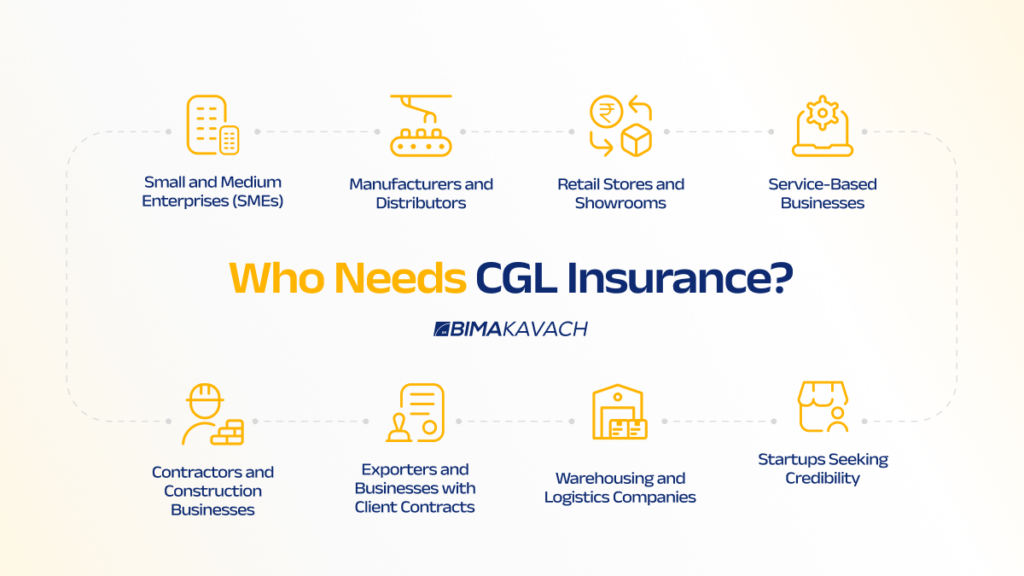
- Small and Medium Enterprises (SMEs)
SMEs often operate with limited financial buffers. A single third-party claim can disrupt cash flow or halt operations without adequate coverage. - Retail Stores and Showrooms
Businesses with customer footfall face higher risks of third-party bodily injury and property damage at their premises. - Manufacturers and Distributors
Product-related injury or damage claims make a CGL insurance policy essential for managing product liability exposure. - Contractors and Construction Businesses
High on-site risks and completed operations liability make a CGL Policy critical for contractors, builders, and infrastructure service providers. - Service-Based Businesses
Companies providing installation, maintenance, repair, or on-site services frequently face accidental third-party damage risks. - Warehousing and Logistics Companies
Handling third-party goods and operating large facilities increases exposure to property damage and injury claims. - Exporters and Businesses with Client Contracts
Many commercial agreements mandate Commercial General Liability Insurance coverage as a contractual requirement. - Startups Seeking Credibility
Holding a CGL Policy signals professionalism and risk preparedness to investors, partners, and clients.
In practice, if a business could be legally held responsible for third-party injury or damage arising from its operations, a CGL Policy is not optional—it is essential.
Things to Consider While Purchasing a CGL Insurance Policy
Buying a CGL insurance policy is a strategic decision that directly impacts how well your business is protected against third-party risks. Before finalising coverage, businesses should carefully evaluate the following factors to avoid gaps and claim disputes later:
- Nature of Business Operations
Assess how your day-to-day activities, customer interactions, and on-site work increase third-party injury or property damage exposure. - Adequate Coverage Limits
Choose sum insured limits that realistically reflect potential claim sizes, legal costs, and industry-specific risk severity—not just the minimum required. - Scope of Commercial General Liability Insurance Coverage
Review what is included under bodily injury, property damage, product liability, and completed operations to ensure alignment with business activities. - Policy Exclusions and Sub-limits
Examine exclusions carefully, especially for professional liability, contractual risks, pollution, and cyber incidents, to avoid unexpected claim rejections. - Add-ons and Policy Extensions
Identify whether add-ons such as contractual liability, tenant’s legal liability, or worldwide jurisdiction are necessary for your operations. - Defence Costs Inside or Outside Limits
Check whether legal defence expenses are included within the sum insured or offered in addition, as prolonged litigation can significantly erode limits. - Claims Handling Reputation of the Insurance Company
Evaluate the insurer’s claim settlement track record, industry expertise, and responsiveness in liability claims. - Compliance with Contractual and Regulatory Requirements
Ensure the CGL Policy meets insurance clauses specified in client contracts, leases, or regulatory guidelines. - Policy Wording and Definitions
Carefully examine the definitions of “occurrence,” “third party,” and “insured” to get a clear picture of how claims will be interpreted.
Purchasing a CGL insurance policy in a structured way helps ensure that your coverage meets the requirements. Also, it genuinely helps you when a claim is made.
Please note that, if you are looking to protect your business from third-party claims, a CGL policy would come to your rescue. However, it is just one of several essential commercial insurance covers available in India. Having the right mix of these will help you chalk out a complete protection strategy for your operations.
Final Thoughts
As a matter of fact, a CGL Policy forms the base of business insurance; however, it is not a complete risk solution. A business should associate it with the overall risk management framework, which should comprise professional indemnity, cyber insurance, employee compensation, and property insurance, among others.
Having a closer look at the coverages & exclusions help businesses make the right decisions, stay away from claim denials, and become resilient over time. For most businesses, the right Commercial General Liability Insurance coverage should not be viewed as an option alone. Rather, it should be seen as a strategic step towards their sustainable development.
Bimakavach makes business insurance easy by identifying the specific risks that your business faces and then matching them with the appropriate coverage. From Commercial General Liability Insurance to specialised business risk covers, Bimakavach partners with top insurance companies in the industry to provide you with clear comparisons, transparent pricing, and expert support at every stage. Whether you are a startup or an expanding business, Bimakavach makes sure that you have the right protection, customized to your business requirements.